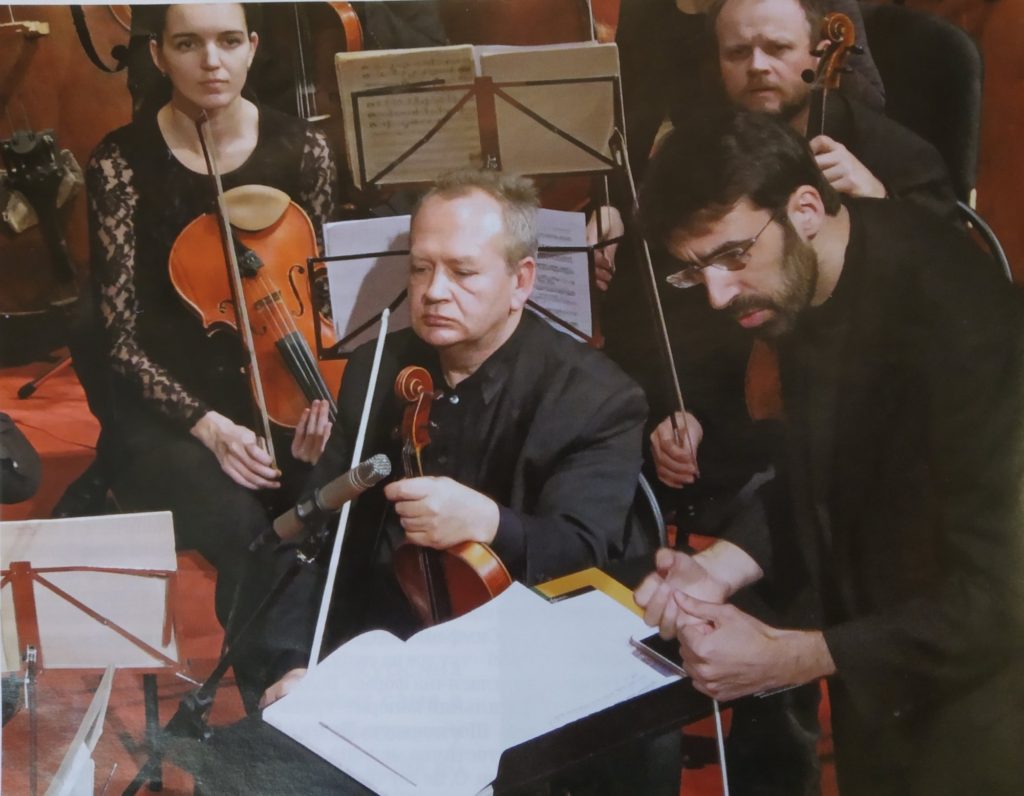
Gaddiel Dombrowner: “Discussion with others is vital”
by : Olena Diachekova (Muzyka, No. 6, 2017, p. 20-22)
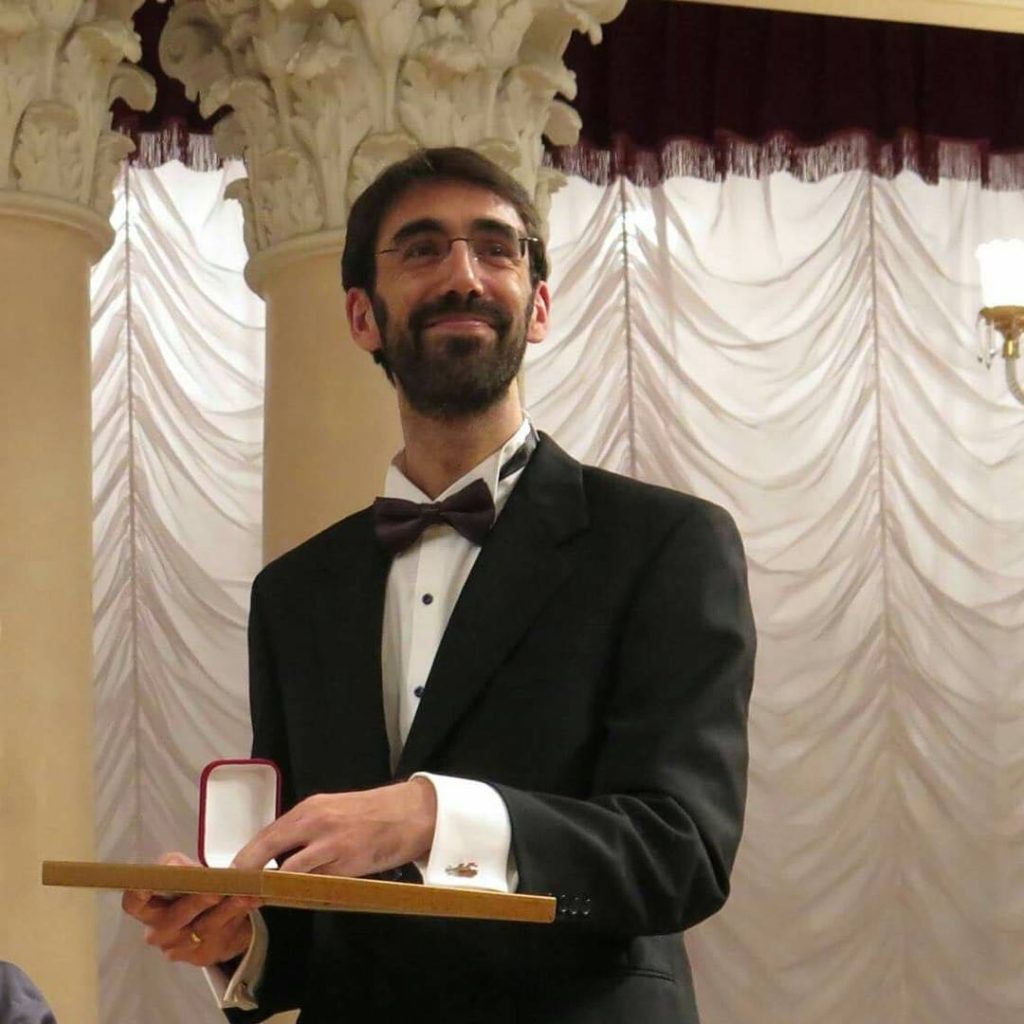
Winner of the third international conducting competition named after Stefan Turchak, Gaddiel Dombrowner (Israel-France), received great musical education as a clarinetist and conductor at the Jerusalem Academy of Music and Dance. This year he received his Master degree at the prestigious Cleveland Institute of Music (USA). During his studies, Gaddiel was invited to serve as assistant conductor at the Cleveland Opera Theater and worked in productions such as “La Boheme” by Puccini and “Le nozze di Figaro” by Mozart. To improve his abilities he participated at many masterclasses including: Mark Stringer, Maurizio Arena, Collin Metters, John Nelson and others and performed with various orchestras around the world (Virtuosi Brunensis, Chamber Orchestra of Croatia, Youth Philharmonic of Alicante, CIM orchestra etc..). Gaddiel is a faculty conductor at MusicFest Perugia sumer festival. Despite his great experience, Ukraine happened to bethe country where the 33 years old musician received his first gold medal in a competition. Gaddiel talked with “Muzika” about the competition and music in general:
Mr. Dombrowner, how did you come to hear about the competition?
I found out about the Turchak competition 3 years ago (2014) but due to the political events then, the competition was postponed. Unfortunately it was very hard to find any information about Turchak himself, since all documentation was not translated to English so the search was quite difficult.
In general, I try to follow as much as possible about competitions around the world. It is a good way for me, especially for a young conductor looking to start a professional career. Competitions give you a ruthless exercise of arriving to your full potential as quick as possible since in real life too, players in the orchestra will judge you also after less than 5 minutes on the podium. In even less time than this, players already know who they have in front of them.
During those years, I assume Ukraine was not so famous in the world…
I would agree. The first time I really discovered a lot about Ukraine was from conductor Theodor Kuchar back in Cleveland. I met with him a few times and he told me all his stories about conducting in Ukraine. And even more than stories, he has many recordings that he made with NASOU for the Naxos company. When I heard those recordings I realized I wanted to conduct them as well. The competition was a great way for this to happen.
So what can you say now about the National Academic Symphony Orchestra of Ukraine?
I would quote for this one of the judges I have spoken with after the competition who said: This orchestra is a real Ferrari. “Driving” a Ferrari. What a dream… (laughs).
Mr. Dombrowner, which part during the competition was the hardest for you?
I wouldn’t say he program of the competition was the hardest part for me. I must say that the hardest for me in competitions is the competition itself. The pressure, you don’t know what to expect with the orchestra sound, meeting new players with whom you have to connect immediately even on a personal level, which is extremely hard. During the days I was here preceding the first round, you are alone in a new country where most people don’t speak English. Which is already quite isolating. And then you are surrounded by people who judge every movement you do. The judges behind you and about 50-60 other judges just in front of you in the orchestra. That’s it, you are surrounded !
But I’m starting to like this kind of pressure. Competitions teach you also how to control your emotions and feeling, then in real life it gets easier.
As for the program, I would say they were all taken from the standard repertoire that every conductor has to know. They are a kind of basic professional repertoire. Beethoven’s fifth, Brahms’ fourth and Dvorak ninth symphonies etc.. – These works are not only classics in the concert halls but also for conductors’ auditions. Learning these works is extremely difficult but it is a knowledge one must have. Therefore for me it wasn’t about building a repertoire through the competition but more to show what I am worth in about 20 minutes. By the way the length of the first round was about double of what other competitions give. About 10-15 minutes…
Was there anything at the competition that surprised you, you were not ready for?
Winning! This win caught me completely by surprise. Every time I went up to the next stage I was surprised by the results. And then many people came up to me to tell me what a great musician I am which I found it hard to believe. My family, parents and wife of course always supported me, it’s natural. But to receive such a flow of compliments was new to me, and being re-invinted by the orchestra was also a great surprise. Until this competition in Kiev, I was a rather “normal” conductor, but now it feels like a new stage of my life is starting. However, I take this win with limited joy since now I have to prove that I am worth of the prize I received back home.
You had to prepare for the competition two modern works: Carpathian Concerto by Miroslav Skoryk and “Sinfonietta” by Evegen Santovitch which was mandatory for the third round. What are your impressions of these works?
I never had a chance to get to know Ukrainian music before. So I didn’t really know what is the “Ukrainian” sound. But I definitely feel now that for example the music of Skoryk is a great insight to this kind of sound. I was very impressed from the main theme of the “Carpathian concerto” the first time I heard. It’s quite amazing and I never encountered something like that. What a wonderful and impressive dance. It couldn’t be a dance of any other country, not French, Italian, nor German. I think this sound is quite special to hear.
Stankovich’s Sinfonietta is more of an academic work – Here everything is how it’s supposed to be: Exposition, development, recapitulation, the classic form. With this there’s also a sort of fatalistic sound. The third movement reminds me a lot of Mahler, the first mvt of Shostakovitch… We do tend many times to compare compositions one with the other. Here it sounds like Prokofiev, here like Mahler. But this work has some personal colors. It is a great combination of new sounds ad colors. I wouldn’t imagine those sounds in the Russian music. I think both Skoryk and Stankovich represent the Ukrainian music and art in two very different ways. I think that the national colors in Skoryk’s music reminds the search for folklore music by Dvorak or Bartok. It has a strong connection to the earth, nature and cultural tradition. With Stankevich music, everything seems to be surrounded by humanism. In this way, his composition reminds me the one of Shostakovich’s. And both of them I think represent your culture of today.
Today as we know questions of Nationalism rise again. In this way, it is as if we returned to the ideas of the 19th century. I am not sure why this happens, but nationalism has become very actual in all Europe. Maybe it is a response to globalization and a wish to keep one’s uniqueness. But in music, uniqueness is always there even with all this globalization. Each composition style is rather easy to recognize. Debussy is hard to miss, Mahler or Mozart.
Mr. Dombrowner what did this competition teach you?
First of all, meeting new people, making connections, talking with other conductors about experiences, work and of course mostly about music opinions. It is a great lesson to talk and to learn from each of them. I think discussing with others is vital. We had quite a tight schedule but I tried to meet as many as I could.
Finally, I would say for me, every competition is not with anyone from the other competitors but with myself. I am trying to win against myself and learn every time something else during these processes.